
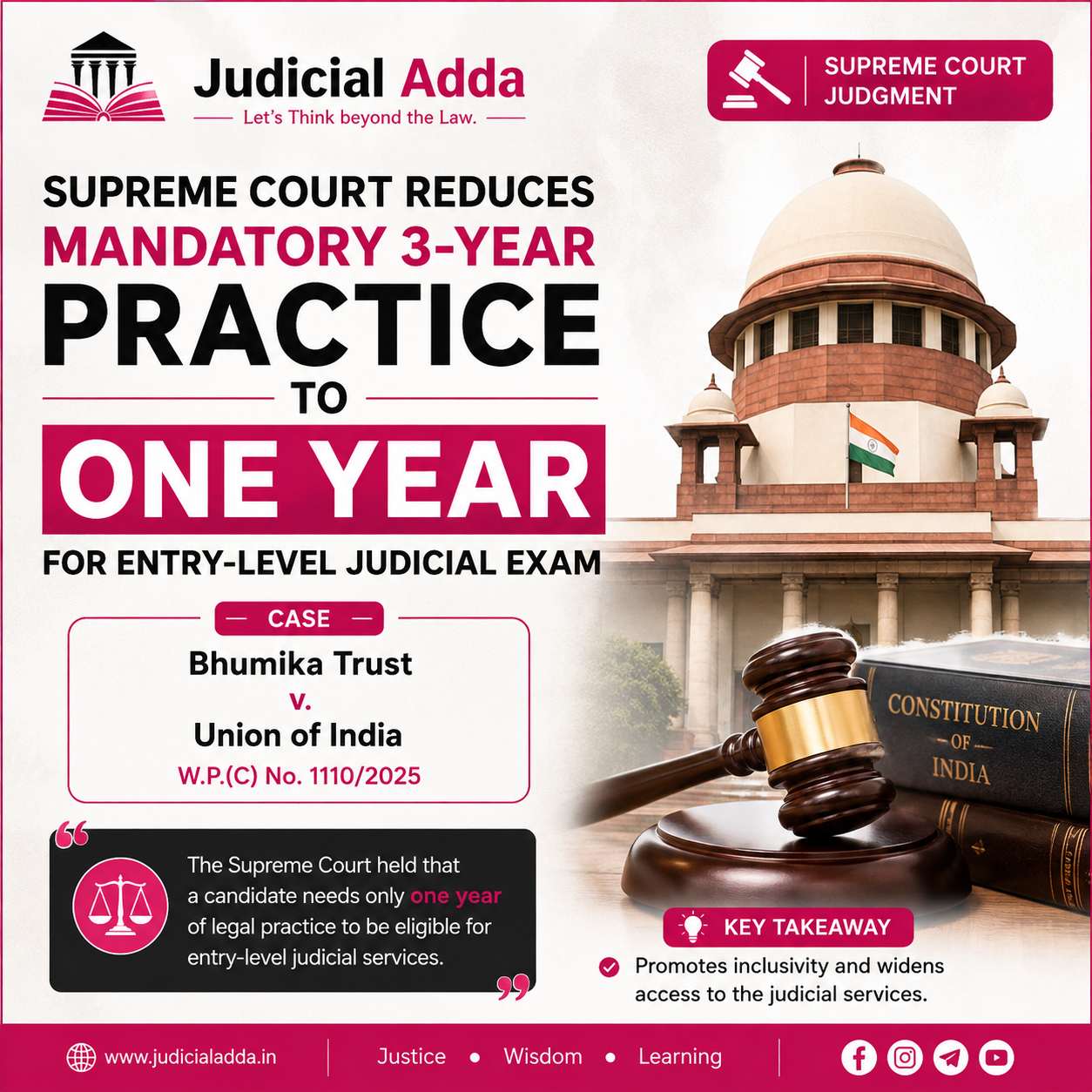
When the Supreme Court restored the mandatory 3 years practice requirement in May 2025, it sent shockwaves through the legal community. Thousands of fresh law graduates watched their dreams of immediate judicial careers vanish. But here’s the twist: in August 2026, the same Supreme Court pulled back and said, “Wait—let’s make this fair.”
What emerged isn’t a complete reversal. It’s something smarter: a hybrid model that maintains rigor while acknowledging the real hardships faced by aspiring judges.
The Context: Why mandatory 3 years practice?
Let’s rewind. In 2025, the Supreme Court decided that judges-in-training needed practical courtroom exposure. The reasoning was sound: a Civil Judge handles matters of life, liberty, and property from day one. Sending a fresh graduate, however brilliant on paper, straight into that role without ever witnessing a trial seemed reckless.
High Courts across India had complained. Young judges appointed without bar experience struggled with court procedures, decorum, and the sheer logistics of running a courtroom. The Court listened and mandated three years of practice as a prerequisite.
But it also created a problem nobody anticipated: sudden, massive displacement for an entire generation of law students who had prepared for entry into judicial service under different rules.
The New Framework: A Three-Act Play
The modified judgment creates a clever three-phase system:
Phase 1: The Transition Window (May 25, 2025 – March 31, 2027)
If you got your law degree before this judgment shifted the goalposts, you get relief. Candidates in this window can apply for Civil Judge (Junior Division) exams without any prior practice. The Court assumes you’ve already completed one year of practice (a legal fiction called “deemed practice”), so you don’t even need a practice certificate.
Who benefits? Students who graduated in 2025 and 2026
Phase 2: The Training Triangle (Post-Selection)
Once selected, here’s where things get interesting. You’re not immediately appointed as a judge. Instead, you become a Trainee Judicial Officer—a new category the Court created.
Your journey:
Year 1: Judicial Academy
12 months at your State’s Judicial Academy
Intensive training in procedure, evidence, judgment writing, and judicial ethics Counts as one year of practice (for eligibility purposes)
Pay: 50% of what a Judicial Magistrate First Class earns
Year 2: Structured Clerkship
First 6 months: Shadowing a District Judge or Additional Sessions Judge Next 6 months: Working under a sitting High Court judge
This also counts as one year of practice
Same remuneration as your Academy year.
By the end, you’ve accumulated three years of credit (0.5 deemed + 1 Academy + 1 Clerkship = 2.5 years, with credit for prior learning), but you’ve also received structured, supervised, quality training—something random bar practice might never provide.
| Bihar Judiciary Notification 2026 | Bihar PCS (J) Syllabus 2026, Download PDF |
Phase 3: The Regular Track (April 1, 2027 Onwards)
From 2027, new rules apply. You need at least one year of actual practice before even appearing in the exam. But you still go through the same training + clerkship cycle post-selection.
You need a certificate confirming your actual presence and participation in judicial proceedings, issued by either:
- The Principal Judicial Officer of the District Court, or
- A senior advocate (10+ years standing) endorsed by the District or High Court authority
Why This Matters: The Real Impact of reducing mandatory 3 years practice
- For Young Lawyers
If you’re graduating in 2026 or 2027, you can jump into judicial exams without waiting. You won’t be penalized for the rule change. Yes, you’ll go through training post-selection, but you’ll be paid during this period—a game-changer compared to unpaid internships elsewhere.
- For Women Candidates
Women advocates often face unique pressures: marriage prospects, familial expectations, and the harsh reality that solo practice in smaller towns means near-zero income for junior advocates. The transition window removes the financial torture of three practice years, making judicial entry feasible without economic devastation.
- For Persons with Disabilities
PWD candidates often struggle to find meaningful practice opportunities. The Court’s acknowledgment that law clerking, court attachments, and structured exposure count toward experience is quietly revolutionary. It means their path doesn’t have to mimic able-bodied advocates exactly.
- For the Judiciary
The Court didn’t capitulate. It maintained that exposure to courts is non-negotiable. But instead of leaving it to chance (will your first three years involve real trial work, or just
file-pushing?), the system now guarantees quality training. Every judge, regardless of bar background, gets the same judicial academy curriculum and supervised clerkship. That’s a win for judicial quality.
The Philosophical Shift
Why mandatory 3 years practice has been reduced?
Here’s what’s brilliant about this judgment: it distinguishes between experience and training. For 20+ years, the system trusted that bar practice alone would produce good judges. The 2025 judgment said that wasn’t working. But the 2026 modification admits something equally important: the quality of bar practice is wildly uneven.
A junior advocate in Mumbai might get rich trial experience. One in a smaller town might spend three years shuffling papers. Relying purely on duration, without ensuring quality, is arbitrary.
By creating a structure where everyone gets standardized, supervised exposure—through formal training and curated clerkships—the Court is actually raising the baseline for judicial competence. You get the best of both worlds: real courtroom exposure and structured preparation.
What Still Matters: The Evaluation
Don’t mistake this for a participation trophy. After your clerkship year, you face a reasoned evaluation by the High Court judge who supervised you. This assessment covers:
- Your conduct and professionalism
- Analytical ability and legal reasoning
- Understanding of procedure
- Case-handling capacity
- Suitability for judicial office
- Only on “satisfactory” evaluation do you get the regular. This is the Court’s saying: We’re giving you a pathway, but you still have to prove yourself.
The Dissent: Justice Vinod Chandran’s Caution
Not everyone agrees. One judge (K. Vinod Chandran) thought the modification was unnecessary. His argument: three years of bar practice is essential because you can’t replicate lived experience in a classroom. Real courtrooms teach you human nature, case management, and the art of law in ways training can’t.
He’s not wrong. But his dissent actually strengthens the majority’s position: the hybrid model tries to get both—the lived experience plus the structured preparation. It’s not perfect, but it’s pragmatic.
The Bottom Line
The Supreme Court’s August 2026 judgment is a masterclass in judicial humility. The May 2025 decision was sound in principle. But the Court recognized that principles must bend to accommodate real hardship, generational fairness, and the evolving infrastructure of judicial training.
It’s not revolutionary. But it’s thoughtful. It’s justice for judges—and about time. (Case Reference: Bhumika Trust v. Union of India, W.P.(C) No. 1110/2025)