

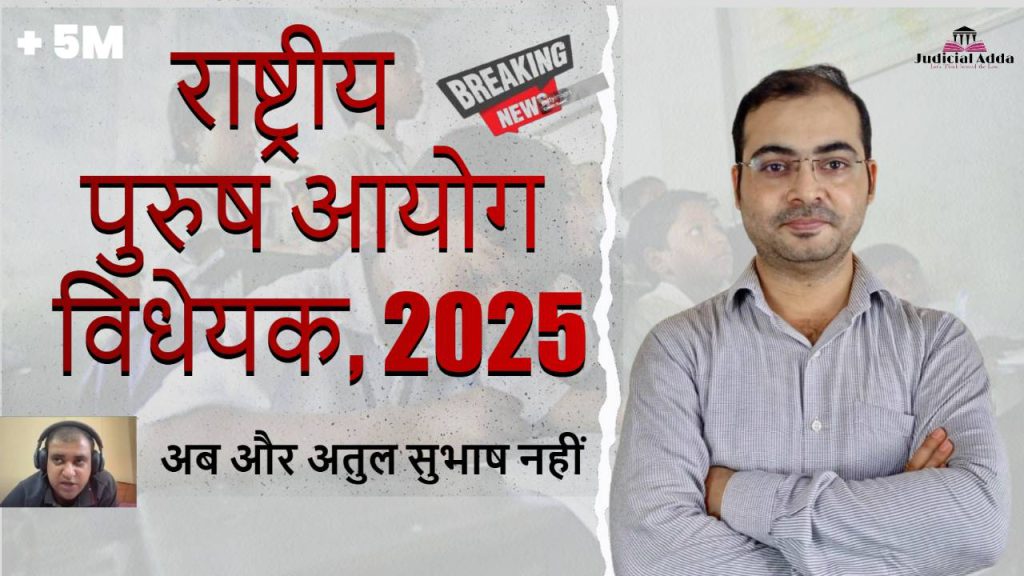
Dr. Ashok Kumar Mittal, a member of parliament, presented the National Commission for Men Bill 2025, a private member bill, to the Rajya Sabha on December 6, 2025.
It is the first significant attempt to establish a statutory body in India that is exclusively concerned with matters pertaining to men. In order to investigate legal discrimination, mental health issues, prejudices in family law, and abuse of specific criminal provisions, the Bill suggests an institutional framework. It has sparked extensive discussion on gender justice, constitutional equality, and striking a balance between accountability and protection in India’s judicial system.
Objectives of the Bill –
In order to safeguard men’s rights and address structural legal and social issues, the National Commission for Men Bill 2025 seeks to establish a legislative organization.
- Create a separate National Commission for Men.
- Examine legislation that disproportionately affect men.
- Talk about male suicide and mental wellness.
- Make sure that everyone has equal access to justice.
- Encourage equity in criminal and family laws.

Key Provisions –
In order to address men’s welfare holistically, the National Commission for Men Bill 2025 proposes structural, legal, social, and financial reforms.
- Structure of Institutions
- The President of India appoints the chairperson of such institute
- Statutory body under the ambit of Ministry of Law and Justice.
- The Chief Justice of India nominates the Legal Advisor.
- Commission consists of six members, three of whom are men and three of whom are women
- Authority comparable to that of current statutory commissions.
- Safeguard against Section 498A IPC i.e. Dowry Death (Now Section 85 and 86 of the Bhartiya Nyayay Sanhita)
- Section 498A will be made bailable and compoundable after a mandatory preliminary police inquiry within 30 days prior to an arrest.
- Penalties for complaints that are proved to be false:
(a) A maximum sentence of five years in prison
(b) Penalties up to ₹25 lakh
(c) Reimbursement for harm to one’s career and reputation.
- Gender – Neutral Reforms –
- Protections against domestic abuse extended to male victims
- Gender-neutral framework for sexual harassment at work Gender-neutral rules for sexual offenses
- False accusations of rape carry a sentence of seven to ten years in jail.
- penalty of up to ₹10 lakh.
- Child Custody and Family Law Reform
- The standard arrangement following a split is shared parenting.
- Equal parental rights unless there is evidence of abuse or neglect
- Provisions against parental alienation:
(a) A maximum sentence of two years in prison
(b) Penalties up to ₹10 lakh
- continued attention to the child’s welfare.
- Rapid Courts Jurisdiction
- Special courts for custody disputes and cases involving false accusations
- Disposal is required within six months.
- quicker alleviation for both real victims and people who have been wrongly accused.
- Media Regulation
- Prohibition of declaring guilt prior to a court ruling
- Media outlets are fined ₹50 lakh for biased reporting.
- Public apology is required.
- Penalties on social media for disseminating unsubstantiated claims is – Three years in prison and Penalties up to ₹25 lakh
- Platforms are required by court orders to remove defamatory content within 24 hours.
- Financial Allocation
- ₹3,650 crore allocated for 2025-2030.
Significance of the Bill –
Through institutional change, the National Commission for males Bill 2025 aims to solve recognized legal, mental health, and family law issues that affect males.
- Reacts to the increase in male suicide rates
- Promote constitutional equality under Article 14 and codifies court protections into legislation.
- Addresses issues of parental estrangement and custody.
- Closes the institutional gap in the creation of gender-focused policies.
Why is the Bill being Criticized?
The National Commission for Men Bill 2025 has drawn criticism for potentially inadvertently weakening current protections and ignoring systemic gender inequality.
- Fear of deterring sincere grievances
- Counter-case intimidation risk
- Concerns about laws that prioritize women being diluted
- Mandatory shared parenting could put victims of abuse in danger.
- The legislative success rate of private member bills is low.